
Tata Consultancy Services (TCS) is likely to maintain its leadership position over the next three years backed by a strong and satisfied client base.

Indian benchmark indices Sensex and Nifty saw gains in early trade, driven by a decline in crude oil prices due to easing geopolitical tensions in West Asia and strong buying interest in the IT sector.

Indian benchmark equity indices, Sensex and Nifty, rebounded in early trade after two days of losses, driven by strong buying in blue-chip IT stocks and a rally in global markets.

N Chandrasekaran's exit marks a major shift for TCS, leaving its leadership to navigate AI disruption without the group chairman's deep expertise.

Indian benchmark indices Sensex and Nifty recorded sharp gains, rising over 1 per cent, driven by strong performances in IT stocks, HDFC Bank, and renewed foreign fund inflows, despite mixed global cues and elevated crude oil prices.
Tata Consultancy Services (TCS) has announced a five-year strategic deal with German automaker Porsche AG worth 1.25 billion (nearly 14,000 crore), which includes the acquisition of Porsche's wholly-owned subsidiary MHP Management- und IT-Beratung GmbH for 320 million (around 3,574 crore). This move is set to significantly expand TCS's consulting footprint in Germany and the broader European market, giving it access to MHP's customer base and specialised talent.

Indian benchmark indices, the BSE Sensex and NSE Nifty, snapped a four-day losing streak, with the Sensex climbing 382 points, primarily driven by a strong rally in IT sector shares. Major IT firms like TCS, Infosys, and HCL Tech saw significant gains, contributing to the market's recovery.

Indian benchmark indices, Sensex and Nifty, experienced a significant downturn, with Sensex tanking 778 points and Nifty closing at a five-month low, driven by surging crude oil prices, geopolitical tensions, and fears of further interest rate hikes by major central banks.

Indian benchmark indices, Sensex and Nifty, experienced a significant drop of over 1 per cent, driven by a bearish trend in global markets, weakness in HDFC Bank and IT firms, and fresh foreign fund outflows.
Indian stock market benchmark indices Sensex and Nifty closed nearly one per cent higher, extending their winning streak for a second day. This rally was driven by softening crude oil prices, positive geopolitical developments, and significant buying in blue-chip IT stocks, despite a broader global tech sell-off.

Indian information technology (IT) stocks, led by Infosys, experienced a significant selloff, dragging the Nifty to a two-month low, primarily due to escalating West Asian tensions pushing crude oil prices higher, and concerns over upcoming large IPOs diverting funds from secondary markets. The sector is also grappling with the long-term implications of AI disruption.

Indian benchmark equity indices, Sensex and Nifty, rebounded in early trade after a three-day slide, driven by strong buying in blue-chip bank stocks and a firm trend in global markets, supported by easing US bond yields and record foreign-currency deposit inflows.

Indian benchmark indices, Sensex and Nifty, extended their rally for the fourth consecutive day, driven by a significant drop in crude oil prices and strong performance from IT firms, despite mixed global cues.

Indian benchmark indices, Sensex and Nifty, opened in positive territory, primarily driven by a strong performance in IT stocks, sustained foreign fund inflows, and a dip in global crude oil prices, despite a hawkish stance from the US Federal Reserve. Track Sensex, Nifty on July 30.

Indian IT companies are experiencing a growing trend towards outcome-based pricing models, moving away from traditional time and material or fixed-price contracts, as artificial intelligence reshapes client engagement and deal structures.

Indian IT companies have significantly reduced their fresh H-1B visa applications for US FY27, a direct consequence of soaring fees imposed by the Trump administration and new lottery system changes that prioritise higher-salaried employees, leading to a seven-year low in registrations.

Indian benchmark indices, Sensex and Nifty, experienced significant declines, with the Sensex falling 493 points and the Nifty dropping for the sixth consecutive day, primarily due to elevated crude oil prices reaching USD 91 per barrel and diminishing hopes for a diplomatic resolution in West Asia.

The Nifty IT index has been one of the worst sectoral performers in calendar year 2026, losing nearly 29 per cent till date compared to the 8 per cent dip in the Nifty 50 index.
Indian benchmark indices, Sensex and Nifty, recorded their fifth consecutive day of losses, driven by investor caution over rising oil prices due to West Asia tensions and renewed concerns regarding US trade tariffs.

'Applying AI to change the lives of Indians and at population scale -- just like we did with DPI [digital public infrastructure] -- is really where it's going to go.'

Bharti Airtel added 7.64 trillion in value over the past five years, making it the biggest wealth creator in India's private sector, while the IT sector, including TCS, Infosys, and Wipro, collectively lost 8.5 trillion in value, according to the latest Burgundy Private Hurun India 500 report.

HCL Technologies remains under pressure after missing Q4 expectations and issuing cautious FY27 guidance. Analysts highlight weak margins, soft demand, and muted growth outlook.
Indian benchmark indices, Sensex and Nifty, closed lower, primarily due to a sharp sell-off in IT stocks, a fresh surge in crude oil prices, and sustained outflows from foreign institutional investors. The Sensex dropped over 300 points, while the Nifty declined by 77.95 points.

Shareholder payouts by India Inc, including dividends and buybacks, increased by 2.2 per cent year-on-year in FY26 to $5.06 trillion, but this growth lagged the 18.8 per cent rise in reported net profit for the third consecutive year, leading to the lowest dividend payout ratio in 12 years.
Indian equity benchmark indices Sensex and Nifty experienced a significant tumble in early trade, with the Sensex tanking nearly 700 points, driven by uncertainty surrounding US-Iran negotiations, a fresh spike in crude oil prices, and persistent foreign fund outflows.

Indian benchmark indices, Sensex and Nifty, closed lower due to significant selling in HDFC Bank and Axis Bank shares, driven by margin-related concerns and escalating US-Iran tensions, which also pushed crude oil prices higher.

Indian IT service providers face heightened competition from AI-native firms in the next three years, potentially eroding their revenue base unless they remain competitive and protect recurring businesses, according to a report by S&P Global Ratings.
Indian benchmark equity indices, Sensex and Nifty, saw gains in early trade, driven by strong performance in banking shares and positive sentiment from Asian markets, alongside optimism surrounding the ongoing US-China Summit.

Indian IT stocks experienced a significant downturn following OpenAI's acquisition of consulting firm Tomoro, intensifying fears that global AI companies are encroaching on traditional IT service models through end-to-end consulting and implementation services.
Shares of information technology (IT) companies were in demand on Friday, with the National Stock Exchange's (NSE's) Nifty IT index rallying 3.3 per cent on . This came after Infosys reported steady sequential growth, driven by health care boost and large deal rampup in a seasonally weak quarter (Q3FY26).

Accenture's revised annual revenue growth forecast and weaker-than-expected fourth-quarter guidance have sent shockwaves through the Indian IT sector, causing major IT stocks and the Nifty IT index to tumble significantly.

Among Sensex shares, Infosys, Tata Consultancy Services, Tech Mahindra, Sun Pharmaceutical, Bajaj Finserv, HCL Technologies, Bajaj Finance, HDFC Bank, IndusInd Bank and Kotak Mahindra Bank were among the gainers. Tata Motors, PowerGrid, Axis Bank, State Bank of India, NTPC, Tata Steel and Adani Ports were the major laggards.
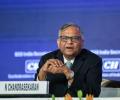
The Tata Group and TCS have announced a multi-dimensional partnership with OpenAI to build AI infrastructure, offer joint solutions, and train Indian youth, aiming to position India as a global AI hub.

Sensex gains over 400 points while Nifty trades above 23,800 amid strong IT sector buying.

Indian mutual funds have significantly reduced their exposure to the information technology (IT) sector, with holdings now at an eight-year low of 6.7% in April 2026, driven by weak earnings growth, global demand slowdown, and concerns over AI-led disruption.

Indian IT services companies are set to significantly increase their acquisition spending to $6.5-7 billion this year, up from $5 billion last year, as they seek to boost revenue and capabilities in areas like Cloud, data, enterprise platforms, and AI amidst a challenging economic environment.

While Infosys never had a presence, Wipro's Venezuelan unit was liquidated many years ago.
Benchmark stock indices Sensex and Nifty closed on a flat note in a choppy session on Wednesday as gains in PSU banks and auto shares were offset by losses in IT stocks.

OpenAI and Anthropic are not simply enabling new software capabilities, they are moving directly into enterprise execution, workflow ownership, and decision orchestration.
